1
Teachers and running costs are automatic. Every school gets an annual budget per student for staff and operations. That money arrives — though what it pays teachers is its own well-publicised fight.
No more applications. No more excuses.
A 160-year-old state school, held together for a decade by its own parents' money, weekends and trade skills — while every application for basic capital funding came back rejected. We have the receipts. All of them.
Sources: CPS Annual Reports to the School Community (VRQA / school website), audited financial summaries. Net = Locally Raised Funds minus the Camps/Excursions/Activities expenditure line in the same audited statements, 2020–25. Gross community contributions since 2007 (including program cost-recovery): $4.7M.
First, the system — in 60 seconds
Most parents assume "the government funds the school" and that's the end of it. Here is how it actually works — because once you see the machinery, everything on this page makes sense.
Sources: DE Student Resource Package policy (PAL); Victorian Auditor-General, "Delivering School Upgrade Projects", 17 June 2026. 日本語の説明はこちら。
Exhibit A — the grant ledger
Every application went into a competitive pool against hundreds of schools in the same condition. A rejection is not a finding that the need isn't real — it's a finding that someone else's emergency outbid ours that year.
Sources: school and department correspondence 2022–2026 held on file by the parent community (copies available); Victorian School Building Authority published project pages for every named school, retrieved 30 July 2026. Neighbouring-school figures count only dollars the Department attributes to that specific school — pooled "shared in $X" statewide allocations are excluded, which makes every comparison here conservative. Every rejection quoted is from the original written notice.
The ranking
In July 2026 we downloaded every school project page the Victorian School Building Authority publishes — 2,696 of them, covering every school in the state — and counted what each one has been given. Then we found ours.
Caulfield South is experiencing the greatest amount of development pressure out of the three Centres… There is generally a lack of "green" public spaces in the core retail area, and no public open space near the activity centre. Glen Eira City Council — Caulfield South Neighbourhood Activity Centre Built Form Framework, adopted into the planning scheme via Amendment C231
Method: every figure is taken from the Victorian School Building Authority's own published project page for that school, retrieved 29–30 July 2026. "Funded" means a school with a stated dollar figure on the register (1,839 of 1,930). Two exclusions make these numbers conservative rather than generous: pooled allocations, where a page says a school "shared in" a statewide sum, are not counted; and where several budget years appear for one project we take the largest figure rather than adding them together. Caulfield Primary separately received $366,625.64 in Planned Maintenance Program funding in 2024 — that is maintenance, not a capital project, and it is excluded here for all 26 schools equally.
The receipts
When the state said no, the community said yes — with fete money, lap-a-thons, trade skills and weekends. Every figure below traces to an invoice, quote or dated email.
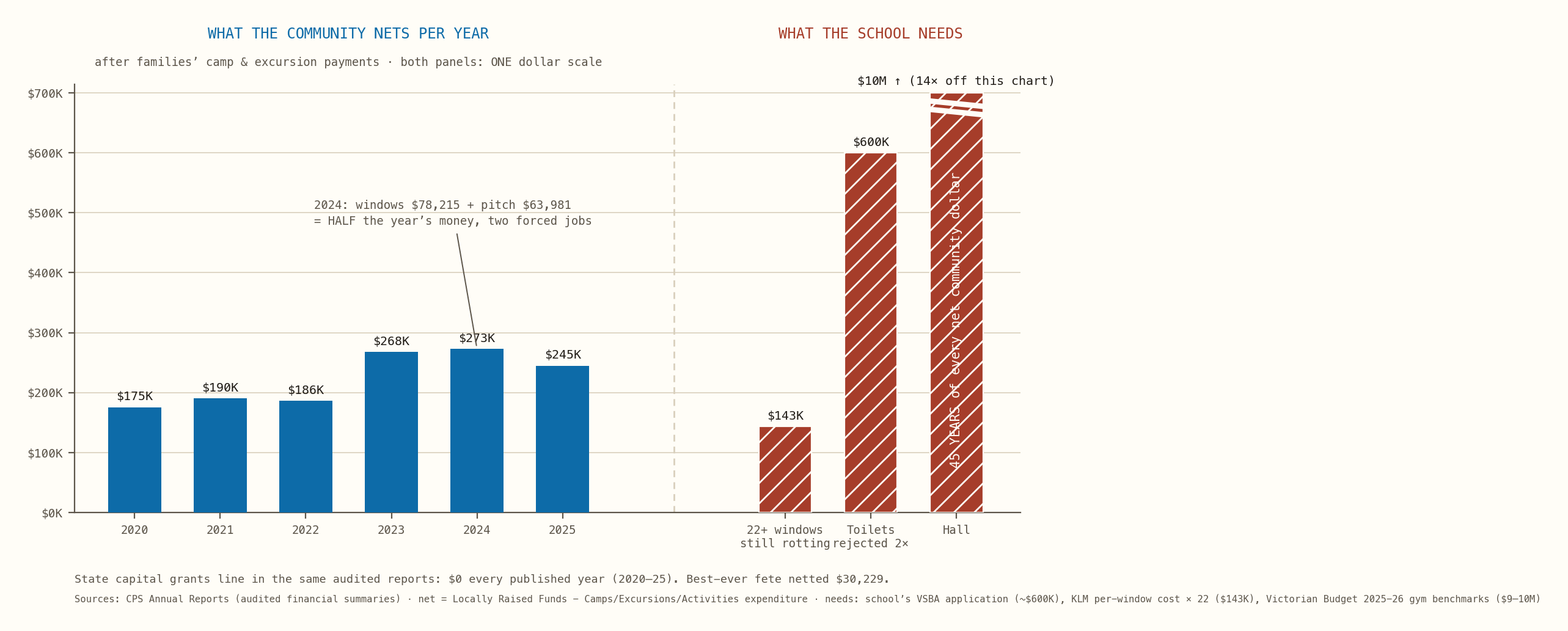
The arithmetic nobody can argue with
Strip out what families pay for their own children's camps and excursions, and this community's entire net contribution — every fundraiser, every hire fee, every voluntary payment — is about $223,000 a year, straight from the audited reports. What we actually raise is smaller again: fundraising averages about $36,000 a year (PFC records), and our best fete in history netted $30,229.
The toilets the Department has rejected twice would take 2.7 years of every one of those net dollars — spending nothing else at all. The hall would take 45 years. That's 331 record-breaking fetes.
Communities cannot fundraise their way out of this. It is a government decision, and it always was.
The unfunded mandate
The state put this school on the Victorian Heritage Register, which obliges conservation-grade repairs at conservation-grade prices. The same state offers no funding stream to pay for them — and its own funding formula admits the problem.
Bigger than one school
This isn't a Caulfield problem. It's an institutional one — ingrained over decades, under governments of both colours, every one of them spruiking "the Education State" while the buildings rotted on schedule.
Schools were prioritised for upgrades based on "advocacy from the school or community" and whether a school has "an active local member" — through "often informal, undocumented processes." Victorian Auditor-General, "Delivering School Upgrade Projects", 17 June 2026
Sources: Victorian Auditor-General's Office — "Delivering School Upgrade Projects" (17 June 2026) and school-maintenance audits (2013, 2017); Department asset-condition ratings as reported therein; "Education State" number plates launched 16 October 2015 (Premier's announcement).
The Auditor-General has confirmed what every parent at every ageing school already knew: funding follows noise, not need. So this campaign is the system working exactly as documented — and every school community in Victoria is welcome to copy our homework. The receipts template travels.
What we're asking — of every party
Everything we ask of one side of politics we ask of the other, identically. Responses — and non-responses — will be shared with our whole school community before the November election.
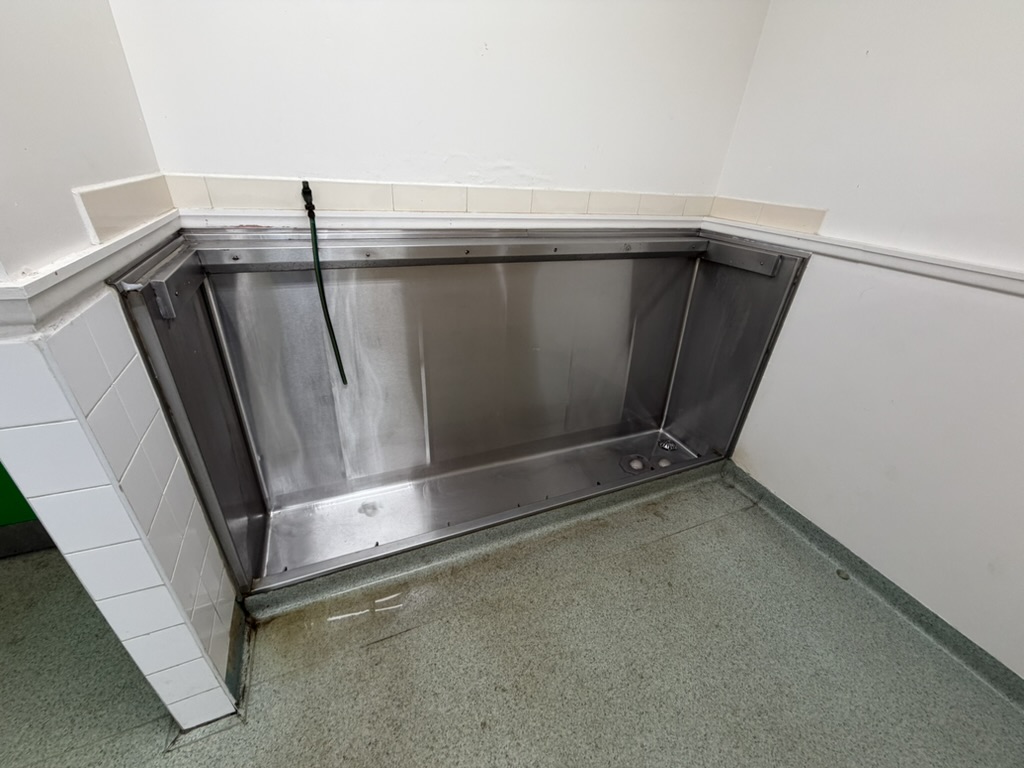
~$600,000 per the school's current application. Occasional seeping sewage, no warm water, three cubicles each for 312 students' boys and girls. Parents deep-clean them several times a year.
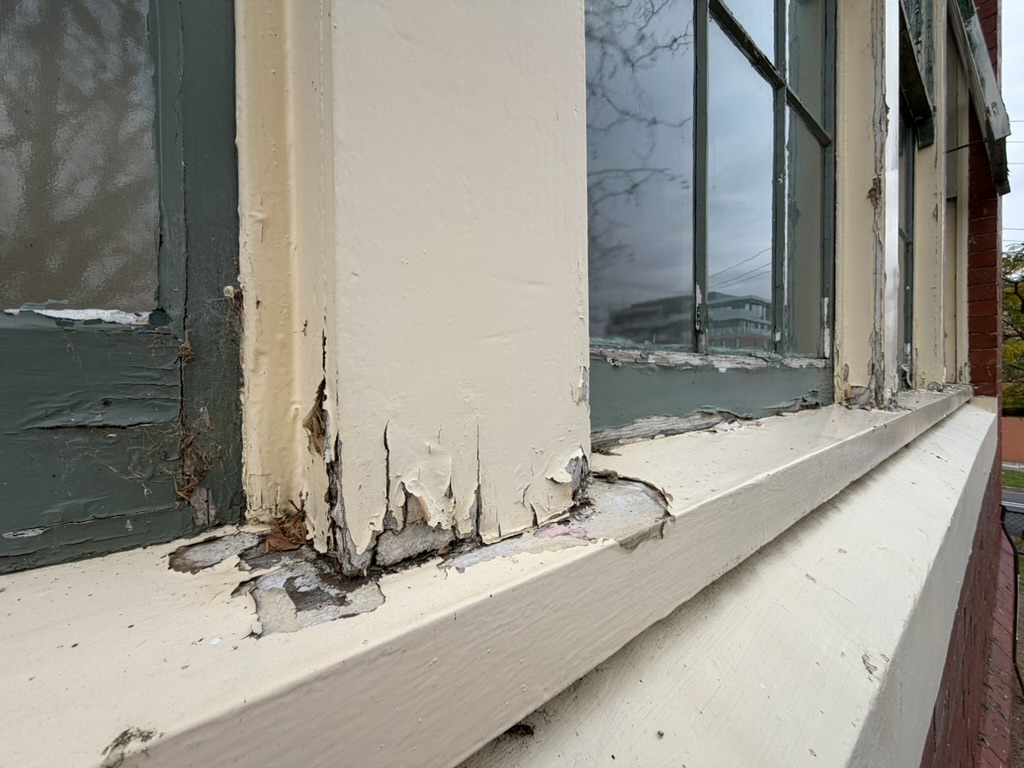
The Department's own 2023 condition assessment recorded "Windows / Timber Framed / Rotting observed". Its own helpdesk rejected the principal's urgent Make Safe escalation in writing: "please try and isolate the area."
The current hall seats about 200 of our 312 students. Assemblies happen outdoors in extreme heat, or not at all. Graduations are capped at two guests per child.
Sources: toilet figures — the school's current department application and June 2026 photo survey; window assessment — Department 2023 condition assessment and helpdesk correspondence (quoted verbatim); window cost — KLM Build invoice, 12 windows, $78,215.50, Heritage Victoria exemption P38354; hall benchmarks — Victorian Budget 2025–26 capital allocations (Caulfield South PS $9.0M, Hampton PS $9.8M); enrolment — DataVic school census 2025 (312).
The honour roll
For eight years the school's maintenance department has been a rotating crew of parents with day jobs. A small sample:
The full itemised Jobs Register is done: 283 parent-performed jobs, every one traced to a dated email record, priced at what a tradesperson would have charged — conservatively $82,000–$123,000 of avoided labour (290 jobs and $91,000–$137,000 counting recollection-sourced work). Highlights include four whole-school air-purifier filter services and a principal's 18-item "handyman jobs list" that a paid contractor had already been booked to quote before a parent took it over.
Join in
Add your name to the community letter, share the receipts, or bring your school into the fight. Everything on this page is invoice-backed — take it, quote it, forward it.